
Report: Ohio’s Capital-Punishment Gridlock a ‘Mockery’ to Justice and Victims
(COLUMBUS, Ohio) — With the release today of his eighth and final “Capital Crimes report,” Ohio Attorney General Dave Yost renewed his call to end the unofficial moratorium on executions that has paralyzed Ohio’s justice system for the better part of a decade.
“During my years as attorney general, not a single sentence has been carried out – a mockery of the justice system and of the dead and their families,” Yost said. “For the worst-of-the-worst killers, Ohio is wandering in a wilderness of lawlessness and desert of justice.”
The Capital Crimes report, an annual statutory requirement of the Attorney General’s Office, provides the procedural history and other information on every case that has resulted in a death sentence since Ohio’s death-penalty law was enacted in 1981.
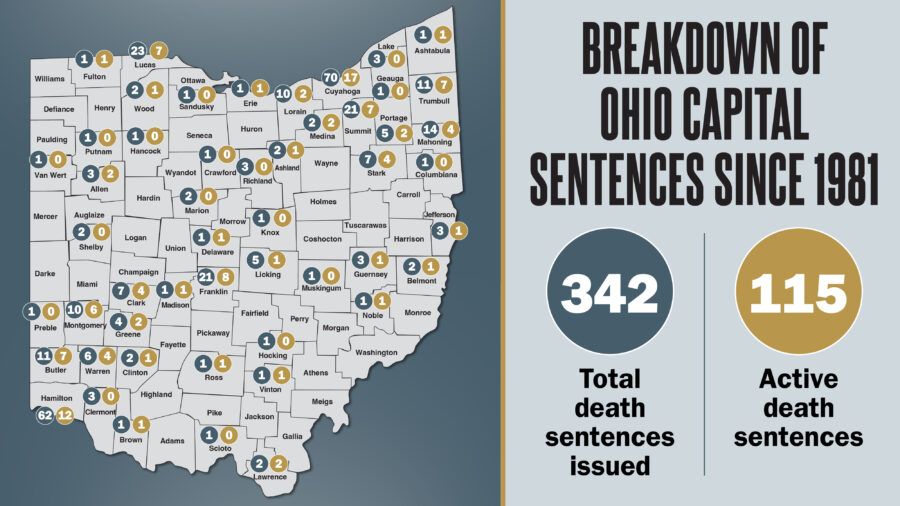
From 1981 through Dec. 31, 2025, the report says, 337 people have received a combined 342 death sentences. Of those, only 56 sentences – one in every six – have been carried out, and none of those since July 2018, more than seven years ago. In the same period, 41 inmates died of natural causes or suicide while waiting on Death Row. An additional inmate, 72-year-old Samuel Moreland, died this past February – almost 40 years after he was sentenced for the murders of two adults and three children in Dayton.
Ohio has the nation’s fifth-largest Death Row population, with 113 inmates facing a combined 115 death sentences. In 2025, one Death Row inmate died, another had charges dismissed and a third was deemed ineligible for the death penalty due to serious mental illness. No additional people were added to Death Row.
On average in Ohio, a condemned inmate spends nearly 23 years on Death Row – mostly due to the numerous avenues for appeal – before an execution date is set. For the first time, the report includes a state-by-state comparison showing that Ohio ranks 12th among 28 capital-punishment states in the length of time that inmates spend awaiting execution.
Also contributing to delays is the reluctance of pharmaceutical suppliers to provide lethal-injection drugs for executions. In the report, Yost reminds Ohio’s elected leaders that pathways exist for Ohio to fulfill the justice it promised.
In January 2025, President Donald Trump issued an executive order to restore the federal death penalty and secure states’ access to lethal injection drugs. Ohio is awaiting that relief from the federal government, Yost said.
Additionally, the report notes that state lawmakers are considering legislation that would permit the use of nitrogen hypoxia as an alternative to lethal injection. The Attorney General’s Office fully supports the bill, Yost said.
“Those on Death Row have had more than their fair share of due process – and second and third helpings of overdue process,” Yost said. “It is past time that we do right by the victims and punish the monsters who killed them.”