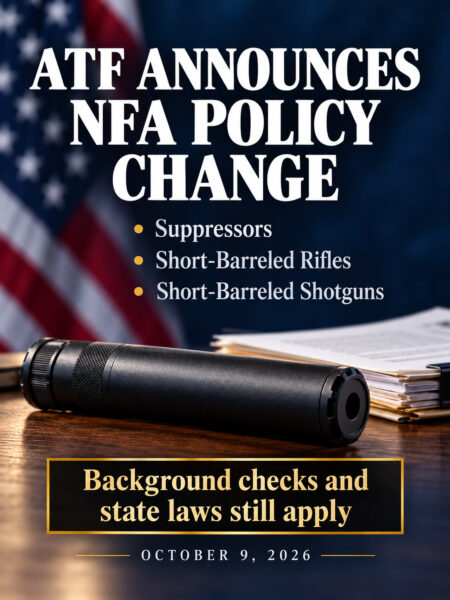

ATF Ends Enforcement of Certain Federal Rules for Suppressors and Short-Barreled Firearms
Background checks, state laws and some travel rules remain in place
WASHINGTON — The Bureau of Alcohol, Tobacco, Firearms and Explosives has announced a major change in how it handles federal rules for suppressors, short-barreled rifles, short-barreled shotguns and certain other firearms.
Under the policy, which took effect Oct. 9, ATF says it will no longer enforce certain National Firearms Act requirements for these items. Those include getting approval before making or transferring them, registering them with ATF and meeting related tax-stamp requirements.
The change applies nationwide. However, other federal gun laws, along with state and local laws, still apply.
ATF explained the policy in an Oct. 9 open letter to gun dealers and the public.
The announcement follows a change in federal taxes and a court ruling in Texas. Congress reduced the taxes on making and transferring these items to $0 through the One Big Beautiful Bill Act.
The National Firearms Act, often called the NFA, has long required special federal paperwork for certain firearms and devices. A transfer means an item changes hands, such as through a sale or gift.
The new policy covers four groups:
– Short-barreled rifles.
– Short-barreled shotguns.
– Suppressors, also called silencers.
– Certain firearms placed in a legal group called “any other weapons.”
That last term has a specific meaning under federal law. It does not mean every other type of gun.
According to the release, Attorney General Todd Blanche announced that the Justice Department would not appeal an August ruling in Silencer Shop Foundation v. ATF.
The ruling came from the U.S. District Court for the Northern District of Texas. According to ATF’s letter, the judge found that certain NFA rules could no longer rest on Congress’s power to collect taxes after Congress reduced the taxes on the covered items to zero.
The court’s order protected only the people and groups covered by the lawsuit. The Justice Department then chose to apply the same enforcement policy to everyone.
That choice is called “enforcement discretion.” In plain terms, it means the government has decided not to enforce certain parts of the law under this policy. It does not erase the entire NFA.
ATF Director Rob Cekada said the agency would keep its focus on “combatting violent crime in American communities.”
For people buying a covered item from a licensed dealer, several familiar steps remain.
Dealers must still complete ATF Form 4473, the federal firearm purchase record. They must also conduct required background checks, keep sales records and follow other federal rules. People barred by law from having firearms remain barred from having these items.
ATF’s updated guidance says background checks remain required unless an existing legal exception applies.
Businesses also still have duties under the NFA. Those making, importing or dealing in these items must continue paying the special federal business taxes that apply to their work.
The policy leaves the full NFA rules in place for machine guns and destructive devices. The $200 making and transfer tax remains for those items, along with the other NFA requirements.
Travel across state lines is another area where rules remain.
ATF says individuals must still obtain approval before taking a short-barreled rifle or short-barreled shotgun across state lines. They can request that approval through ATF Form 20.
That requirement applies even when the firearm is not registered under the NFA.
The agency also warned that state laws can differ along a travel route. A person may face restrictions in a state they pass through, even if the item is allowed where the trip begins and ends.
State and local laws remain a key part of the announcement.
Some states ban certain NFA items. Others allow them only when specific conditions are met, such as federal registration. ATF’s policy does not remove those limits.
For Ohio residents, the federal announcement alone does not settle whether a particular item may be made, bought, possessed or carried under state law. ATF advises owners and dealers to check with local authorities or seek legal advice about the laws that apply.
ATF will continue accepting voluntary registration and transfer applications. These include Form 1 applications for making or registering an item and Form 3 or Form 4 applications for transfers.
The open letter also addresses a separate federal rule governing dealer sales of short-barreled rifles and shotguns. ATF said it is preparing new rules for an approval process outside the NFA system. While that work is underway, the agency says it will not enforce that specific dealer approval provision.
ATF’s online questions and answers, updated Oct. 16, also explain that the policy could change.
The agency says enforcement could resume if Congress changes the tax, a court overturns or ends the order, or the Justice Department withdraws its guidance.
ATF also says federal law does not automatically protect owners of unregistered items if enforcement returns. Nor does it generally allow those items to be registered later.
Members of the public and licensed dealers can read the ATF guidance and frequently asked questions. Questions about the announcement may be sent to the agency’s Firearms Industry Programs Branch at FIPB@atf.gov.