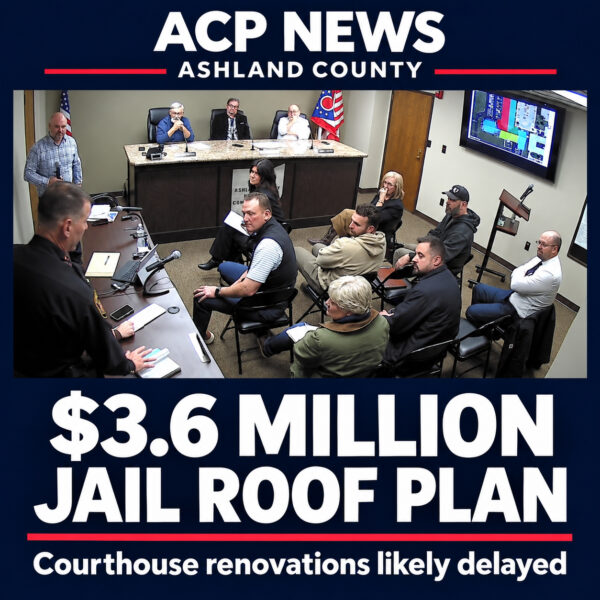

Leaking Jail Roof Prompts $3.6 Million Plan, Likely Delay in Courthouse Renovations
ASHLAND — A proposed $3.6 million roof project at the Ashland County Jail moved forward during a special commissioners meeting after officials described nearly 60 buckets catching leaks, damage to electrical panels and booking officers working under umbrellas.
The project would draw roughly $2.9 million from the county’s capital facilities fund, with another $700,000 contributed from the sheriff’s jail operations and maintenance fund. Commissioners acknowledged that using the money for the jail would likely delay planned courthouse renovations.
An oversight committee gave its approval by roll call near the end of the meeting. Commissioners discussed placing the contract on their Thursday agenda for a separate board action.
Much of the meeting focused on questions from Probate and Juvenile Court Judge Kellogg, Commissioner-elect Brandon Carpenter and Clerk of Courts Myers about the contract, warranties, contractor selection and the effect on other county building projects.
The sheriff said the leaks have become more than a maintenance nuisance.
“My last count of the buckets up there was close to 60 across the building,” he said.
Water has damaged electrical panels, and officials do not know everywhere it is traveling inside the building. The sheriff also raised concerns about computers, possible mold and further damage that may remain hidden.
“I literally had booking officers sitting in booking with umbrellas because of leaks,” he said.
The sheriff said significant leaks developed within about six months of his taking office, although the building’s roof problems go back years.
Judge Kellogg said a leaking jail roof was unacceptable, but she wanted assurances that the county’s next investment would solve the problem and protect public money.
She asked whether the county engineer had reviewed the proposal. Commissioners said he had not. Later in the discussion, they explained that they generally rely on building specialists for those projects because the county engineer’s work primarily involves roads and civil engineering.
Kellogg also questioned whether the county prosecutor had reviewed the contract. Initial responses differed before a commissioner said the prosecutor had reviewed and approved it. Commissioners emphasized that the board itself had not yet approved the contract.
Drawing on her experience in private legal practice, Kellogg identified provisions she believed deserved closer attention, including whether a contractor could perform additional work without specific written county approval.
She also questioned whether the construction drawings and specifications were incorporated into the contract, whether all masonry and related work were included in the price, and what protections would apply if unexpected conditions increased costs.
Kellogg asked for clearer warranty language covering labor, materials, workmanship and removal or replacement of defective work. She also wanted a construction schedule with milestones and an explanation of the county’s remedies if those milestones were missed.
“We’ve got inmates,” she said, questioning how construction would be coordinated while the jail remained occupied.
A Garland representative acknowledged that the materials provided to Kellogg did not include the completed specifications and said those could be incorporated into the contract. He also said a written schedule could be supplied.
The representative said masonry work was included and described the proposed price as a not-to-exceed estimate with contingencies.
Garland personnel would inspect work three to four times a week, he said.
Courthouse Funding Raises Concerns
Kellogg also questioned how the jail expenditure would affect money available for courthouse renovations.
She cited existing commitments against the capital facilities fund and asked how commissioners intended to replenish it while paying for the jail roof and completing the new county administration building.
“To be transparent, I want to make sure that there’s some money to fix up our courthouse,” she said.
Commissioners said the capital fund receives county casino tax revenue and an allocation equal to 4% of county sales tax receipts.
The sheriff would contribute $700,000 immediately, then repay the remaining county contribution from the jail fund over a period discussed as up to 30 years. Commissioners described that as a worst-case repayment period and said stronger revenues could allow repayment sooner.
County Auditor Cindy Funk said approximately $2 million was available after existing commitments. She outlined a possible funding path involving about $500,000 in additional revenue during the first half of the coming year and approximately $300,000 in excess interest income.
Any transfer of interest earnings from the general fund would require commissioners’ action.
Commissioners said courthouse renovation plans were still being developed, with no final construction estimate. One commissioner anticipated that design work could continue through 2027 and that construction might not begin until 2028, depending on available money.
They also said the courthouse work would need to proceed in phases so court offices could continue operating.
The board reiterated its intention to complete projects with available funds rather than borrow money or issue bonds.
Carpenter Asks About Competition
Commissioner-elect Brandon Carpenter questioned how Garland had been selected and whether competing building materials companies had been given an opportunity to propose alternatives.
Carpenter said other companies had contacted him expressing interest in the project and a belief that they could save taxpayers money.
Garland representatives said local installation contractors had participated in a bidding process. Commissioners defended their longstanding relationship with Garland, citing its previous work on county roofs.
They said the county maintains a five-year roof plan that is reviewed annually.
Commissioners also pointed to problems with earlier county projects awarded through low bidding, including courthouse windows, as a reason they valued contractors with established records.
Officials described the proposed purchasing arrangement as using a state contract. The discussion distinguished that arrangement from the competition among contractors for installation work.
Warranty and Roof Design Examined
Garland representatives described a metal roof system supported by new framing, insulation and a protective underlayment over the existing roof.
The new panels would use concealed attachments and floating clips designed to accommodate expansion and contraction. Representatives said exposed fasteners backing out of the current roof have contributed to leaks.
The wash bay roof would receive changes intended to improve drainage and eliminate areas where water collects.
Representatives described a 30-year warranty with no dollar limit and a separate three-year contractor workmanship warranty. When questioned about later workmanship problems, Garland said responsibility for covered repairs would fall to the manufacturer during years four through 30.
Carpenter also questioned roof-slope restrictions in the warranty information. A representative said approximately 99% of the roof fell within the slope being discussed, but said the remaining technical coverage question would need clarification.
Routine maintenance, including gutter cleaning, would remain necessary.
Officials Weigh Cost of Waiting
Commissioners and Garland representatives said completing the project at once could save approximately $400,000 to $500,000 compared with spreading the work across multiple years.
The sheriff said removing the existing roof entirely would create security and operational problems and could add an estimated $1.5 million to $2 million.
Common Pleas Judge David Stimpert acknowledged the need to address the leaks despite the effect on courthouse plans.
“You got to fix the roof,” he said.
Officials said a decision before Jan. 1 would help secure current pricing, although the construction schedule would depend on contractor availability and delivery of materials.
Following the oversight committee’s approval, commissioners discussed bringing the contract before the board Thursday.