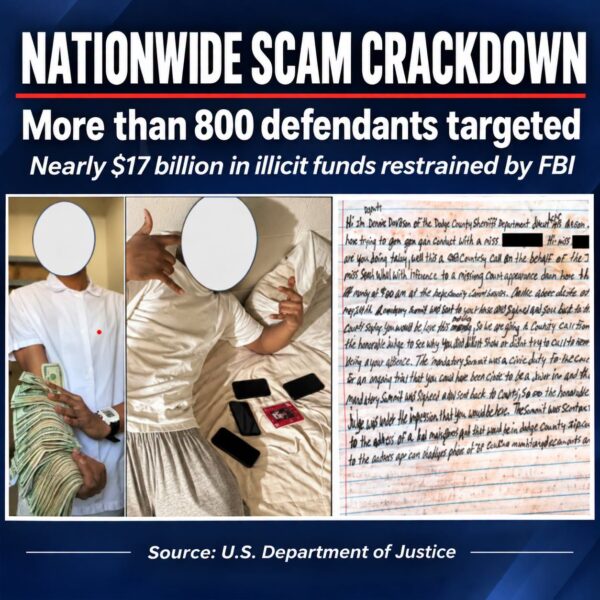

Nationwide Crackdown on Scammers Targets More Than 800 Defendants; FBI Restrains Nearly $17 Billion in Illicit Funds
Federal authorities dismantle international scam operations, target prison-based jury duty scams and warn Americans ahead of the holiday season
WASHINGTON, D.C. — The U.S. Department of Justice announced Tuesday, November 24, 2026, the results of a nationwide and international crackdown on criminal scam networks responsible for targeting Americans through fraudulent telephone calls, cryptocurrency investment schemes, government impersonation and other forms of financial fraud.
Since President Donald Trump signed Executive Order 14390 on March 6, federal prosecutors have taken action in more than 400 cases involving over 800 defendants, with investigations spanning 85 federal judicial districts.
The cases include newly filed criminal charges, extraditions, guilty verdicts and criminal sentences. Federal investigators have also assisted authorities in more than 10 countries with raids targeting fraudulent call centers and overseas scam compounds.
Thirty defendants have been extradited to face scam-related charges in United States courts.
“Predatory scams against the American people will not be tolerated,” said Attorney General Todd Blanche. “The unprecedented results of this surge are just the beginning. We will continue prosecuting those who perpetrate these schemes and disrupting the activities of transnational criminal organizations before they reach American shores.”
Georgia Prison Inmates Accused of Operating Jury Duty Scams
Among the cases highlighted by the Justice Department is an investigation involving current and former members of Georgia prison gangs accused of using contraband cellphones to impersonate law enforcement officers and demand money from unsuspecting victims.
According to federal authorities, the suspects contacted individuals and falsely informed them that they had missed jury duty. Victims were threatened with arrest unless they paid what the callers claimed was a court-imposed fine.
Fourteen individuals were charged in three indictments filed in federal and state courts in connection with the alleged schemes.
Another 17 defendants were charged in state court in connection with an alleged operation to smuggle contraband cellphones into Georgia prisons.
Authorities also seized websites linked to the fraudulent jury duty operations.
Photographs released by the Justice Department show Georgia prison inmates displaying large amounts of cash and multiple cellphones. Investigators also released a photograph of a handwritten script used during fraudulent telephone calls.
The U.S. Postal Inspection Service seized three internet domains associated with the jury duty impersonation schemes, redirecting visitors to official government servers displaying seizure notices.
For residents of Ashland County and surrounding communities, the investigation serves as a reminder that a telephone call from someone claiming to represent a sheriff’s office or local court does not necessarily mean the caller is a legitimate law enforcement officer.
FBI Operation Blackout Targets International Scam Compounds
The FBI’s global anti-scam initiative, known as Operation Blackout, has targeted criminal organizations operating across Asia, Africa and the Middle East.
According to the Justice Department, the operation has resulted in:
– Nearly $17 billion in illicit funds restrained.
– More than 14,000 digital devices seized.
– More than 29 overseas scam compounds identified, disrupted or dismantled.
– More than 50 individuals facing federal charges.
– More than 320 additional individuals arrested or detained by foreign authorities.
– More than 2,200 human trafficking victims liberated and repatriated after being forced to work inside scam compounds.
FBI Director Kash Patel also reported that federal efforts have directly warned more than 11,000 Americans about scam attempts and prevented more than $690 million in potential victim losses.
“The message to these scam syndicates is clear: if you target Americans, justice will find you,” Patel said.
Through a separate FBI initiative known as Operation Level Up, authorities have prevented more than $143 million in victim losses since March 6 and frozen more than $350 million in assets through the FBI’s Recovery Asset Team.
Americans Lost an Estimated $68 Billion to Scams in 2025
According to Gallup research cited by the Justice Department, Americans lost an estimated $68 billion to scams in 2025 alone.
Approximately one in 10 American adults experienced a scam either personally or through someone living in their household.
The consequences extended beyond financial losses. Nearly three out of four scam victims reported a negative impact on their mental health or overall well-being.
Some victims lost their retirement savings, while others were left struggling to pay everyday living expenses after transferring money to individuals they believed were legitimate government officials, investment advisers or romantic partners.
Scammers Targeting Seniors, Military Personnel and Grieving Families
Federal prosecutors filed or unsealed charges against more than 30 scam defendants during the month leading up to Tuesday’s announcement.
Other investigations highlighted by the Justice Department include:
– Southeast Asian scam centers allegedly operating fraudulent cryptocurrency investment schemes.
– Individuals accused of demanding advance payments for nonexistent inheritances.
– A list broker in Mexico accused of knowingly selling the names and contact information of elderly Americans to scammers.
– A cremation services provider accused of engaging in deceptive pricing practices targeting grieving families in violation of a court order.
– A Peruvian call center operator accused of threatening Spanish-speaking Americans with arrest or deportation unless they purchased English language-learning products.
– Twelve defendants accused of participating in fraudulent sweepstakes targeting elderly Americans.
– A Nigerian national extradited from the United Kingdom for allegedly targeting American military personnel in a scheme to steal their military pay.
Authorities also identified a cryptocurrency investment conspiracy operating from scam centers in Cambodia that allegedly targeted at least 174 American victims.
A Chinese national was extradited from the Netherlands in October and arraigned in federal court in California for his alleged involvement in that conspiracy.
Homeland Security Investigations Reports More Than 300 Arrests
Since March 6, Homeland Security Investigations offices across the country have reported more than 300 arrests, indictments involving more than 100 defendants and approximately 80 convictions and guilty pleas.
Investigators have also seized, frozen, restrained or recovered more than $120 million in illicit proceeds.
Those assets include money held in bank accounts, cryptocurrency, cash, precious metals, vehicles and real estate.
Meanwhile, the U.S. Secret Service reported restraining more than $200 million in illicit funds and disrupting 1,780 internet domains operated by scammers.
Secret Service investigators also recovered more than $119 million while investigating more than 1,540 incidents involving compromised business email accounts.
Overseas Operations Target Fraudulent Websites and Call Centers
The U.S. State Department has provided training, technical assistance and investigative resources to international law enforcement agencies working to dismantle scam networks.
In Southeast Asia, those efforts helped authorities freeze more than $1 billion in stolen cryptocurrency and take down more than 1.4 million fraudulent websites and accounts.
In Thailand alone, federally funded forensic tools helped investigators analyze more than 10,000 electronic devices and hard drives.
In Moldova, authorities arrested three suspects in October in connection with an alleged online romance scam that took $440,000 from American and European victims in a single month.
Additional raids resulted in the closure of five call centers and the detention of eight suspected coordinators accused of operating fraudulent cryptocurrency trading platforms.
Federal Regulators Target Fraudulent Investments and Deceptive Businesses
The Federal Trade Commission filed 16 enforcement actions during the crackdown involving deceptive business practices, fraudulent technical support services, debt relief schemes, unauthorized billing, health insurance fraud and government impersonation.
The agency also worked to remove fraudulent social media pages and 19 websites impersonating the FTC or its officials.
The Securities and Exchange Commission filed enforcement actions against 39 entities accused of submitting false regulatory documents to appear as legitimate American investment advisers.
The SEC also announced charges involving an alleged investment fraud scheme associated with BG Wealth Sharing Ltd. and DSJ Exchange Pty Ltd. that raised more than $130 million from tens of thousands of investors in the United States and abroad.
Federal regulators are warning investors that scammers frequently use social media platforms, messaging applications and false claims of government registration to convince victims that fraudulent investment opportunities are legitimate.
FCC Approves Cellphone Jamming in Prisons and Jails
On November 19, the Federal Communications Commission approved a new rule allowing federal and state prisons and jails to use cellphone jamming technology to combat illegal activity involving contraband mobile phones.
The rule is intended to disrupt criminal operations conducted by inmates, including fraudulent jury duty calls and extortion schemes targeting American veterans.
The FCC also reported that its enforcement efforts have stopped approximately 296 million illegal robocalls and resulted in the blocking of more than 1,400 service providers.
The agency estimates those efforts have saved Americans at least $38 million.
Authorities Encourage Families to Discuss Scams During the Holidays
With Thanksgiving and Christmas approaching, the Justice Department is encouraging Americans to discuss their experiences with scams through a public awareness campaign called “Share Your Scam Story.”
Holiday gatherings provide an opportunity for families to discuss suspicious telephone calls, text messages, emails and online investment offers, particularly with elderly relatives who may be targeted by criminals.
Residents should be especially cautious when someone claims to be a law enforcement officer and demands immediate payment to avoid arrest.
Other common warning signs include:
– Demands for payment through gift cards, cryptocurrency or wire transfers.
– Threats of immediate arrest over missed jury duty.
– Requests to keep financial transactions secret from family members.
– Unsolicited investment opportunities promising guaranteed returns.
– Requests for banking information, passwords or verification codes.
– Unexpected telephone calls claiming a relative is in jail or needs emergency financial assistance.
– Callers instructing victims not to hang up or contact another person.
Anyone receiving a suspicious call should hang up and independently contact the agency the caller claims to represent using a verified telephone number.
Do not rely on caller ID, which can be manipulated to display the name or telephone number of a legitimate government agency.
If money has already been transferred, contact your financial institution immediately and report the suspected fraud to law enforcement.
Suspected internet-related fraud can be reported to the FBI at www.ic3.gov, while other fraudulent activity can be reported to the Federal Trade Commission at ReportFraud.ftc.gov.
Federal authorities emphasized that the nationwide crackdown remains ongoing.
All defendants facing criminal charges are presumed innocent until proven guilty beyond a reasonable doubt in a court of law.