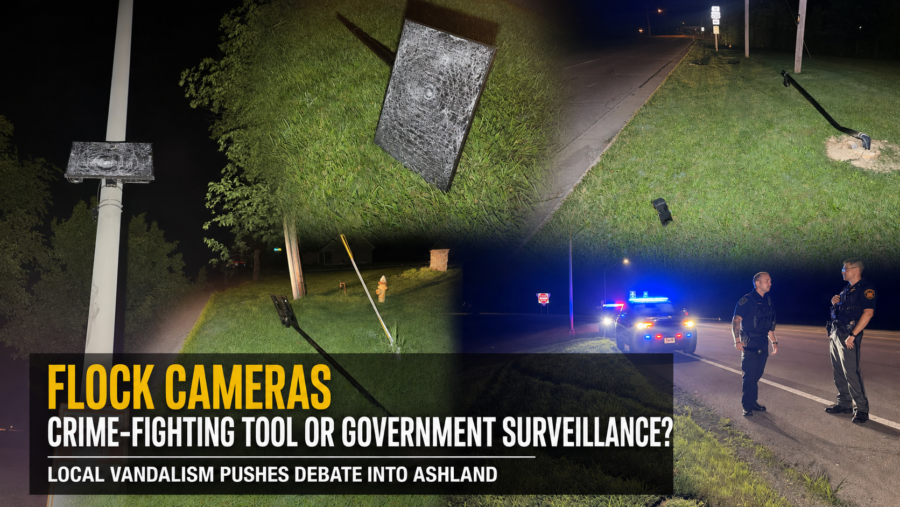

Flock Cameras: Crime-Fighting Tool or Government Surveillance? Local Vandalism Pushes Debate Into Ashland
ASHLAND, OHIO — Flock Safety cameras have become one of the fastest-growing pieces of law-enforcement technology in Ohio and across the country. Supporters say the license plate-reading cameras help police find stolen vehicles, track suspects, locate missing people and solve crimes faster. Critics say the same technology creates a powerful surveillance network capable of documenting the movements of ordinary drivers who have done nothing wrong.
That debate is no longer limited to large cities or civil-liberties groups. It has reached Ashland, where police dispatch records show multiple Flock cameras were damaged or vandalized late Wednesday night, July 8, 2026.
According to a Wooster-Ashland Regional 911 Council of Governments call summary, the first call came in at 10:34 p.m. for “large parts of a car” in the roadway across from Arby’s on Claremont Avenue.
Minutes later, an officer advised that it appeared someone had driven through a Flock camera. As officers checked the city, dispatch notes listed several additional damaged cameras, including one near Meadow Brook, one on West Main Street, one at U.S. 42 and the U.S. 250 bypass, and another near Home Depot.
A BOLO was requested after dispatch noted that “all Flock cameras in Ashland are being vandalized.” The incident led to an active police investigation.
What Flock Cameras Do
Flock cameras are automated license plate readers, commonly called ALPRs. They are mounted along roadways, at entrances to neighborhoods and near businesses, schools and other public areas.
The cameras capture license plates and vehicle information, including the vehicle’s make, model, color, body style and distinctive features. Authorized users can then search that information during an investigation.
Flock Safety says its license plate readers do not use facial recognition and do not identify the driver or passengers inside a vehicle. According to the company, searches can be based on license plates and vehicle characteristics, including trailers, bike racks, toolboxes, aftermarket wheels and other identifying features.
Flock Responds to Surveillance Concerns
In statements addressing public concerns about the technology, Flock Safety said its system was designed as a focused investigative tool rather than an unrestricted surveillance database.
“You’ve probably heard of license plate readers and thought surveillance,” the company said. “I understand why it feels that way, but that’s not what we built.”
Flock said its license plate readers are intended to be searched after a crime or emergency, such as a stolen vehicle, hit-skip crash, kidnapping or missing-person case.
“The LPR system doesn’t track people and it doesn’t predict when crime will happen,” the company stated. “You can only search for vehicles on our LPR cameras.”
The company said investigators are required to document why they are conducting a search. According to Flock, users may be required to enter an offense type, case number, reason for the search and a limited time and location.
Flock also said every search and data-sharing request is logged, recording who conducted it, when it was conducted and the reason given. Agency administrators can audit those records to identify searches that do not appear consistent with legitimate casework.
Flock’s published policy says license plate data is automatically deleted on a rolling 30-day schedule by default, although retention periods can differ when required by a government customer’s policy or applicable law. The company says its system captures vehicle information but does not reveal who is driving or riding in the vehicle. Flock’s license plate reader policy also describes its retention, access and auditing safeguards.
Those assurances, however, do not satisfy every critic. Opponents argue that even if a camera does not identify a person by name or face, repeatedly recording a vehicle’s plate, time and location can still reveal that person’s movements when combined with motor-vehicle records or other information.
The Pro Side: Why Police Like Them
Law-enforcement agencies argue Flock cameras give officers a faster way to find vehicles connected to crimes. Rather than relying only on a witness description or waiting for a vehicle to pass an officer, police can search for a plate, vehicle color, make, model or other identifying details.
Supporters say the cameras can help in cases involving:
Stolen vehicles
Wanted suspects
Missing or endangered people
Hit-skip crashes
Burglaries and thefts
Drug investigations
Kidnappings
Violent crimes
In Cleveland, Deputy Chief Jarod Schlacht told officials the city would lose “one of the most valuable investigative tools” if its Flock cameras were not renewed. Cleveland officials said the cameras had been used in violent-crime investigations, stolen-vehicle recoveries, missing-person cases and hit-skip crash investigations.
There is also a staffing and cost argument. Instead of assigning officers to sit at intersections watching for a particular vehicle, cameras can operate continuously and send an alert when a plate associated with a stolen vehicle, wanted person or active investigation is detected.
For smaller agencies with limited staffing, supporters say that capability can extend an officer’s reach and provide investigative leads across jurisdictional boundaries.
The Con Side: Privacy, Oversight and Public Trust
The central concern raised by opponents is that Flock cameras do not record only suspects. They photograph and catalog every vehicle that passes within their field of view.
Privacy advocates argue that when enough cameras are connected, the system can potentially reconstruct a person’s routine movements, where someone works, worships, shops, receives medical care, visits friends or participates in political activity.
The American Civil Liberties Union has criticized the expansion of automated license plate readers, arguing that a system initially promoted for individual criminal investigations can develop into a much broader tracking infrastructure.
Critics also question whether internal logs and agency policies provide enough protection when the public may not know which agencies can access the information, how widely it is shared or how often searches are audited.
Congressman Introduces Surveillance Accountability Act
The debate has now reached Congress.
On April 23, 2026, U.S. Rep. Thomas Massie, R-Kentucky, introduced House Resolution 8470, known as the “Surveillance Accountability Act.” Rep. Lauren Boebert, R-Colorado, joined Massie as a co-sponsor.
The legislation was referred to the House Judiciary Committee. It remains a proposed bill and has not become law.
The bill would amend federal law to require a warrant supported by probable cause for government searches that significantly affect a person’s privacy or security. It would also establish a presumption of privacy for data, metadata and personal information held by third parties, including telecommunications providers, internet companies, cloud-storage companies, financial institutions and data brokers.
Most directly related to Flock cameras, the proposal states that exceptions to the warrant requirement could not be interpreted to permit the warrantless “collection, retention, querying, or analysis” of license plate images, vehicle metadata or vehicle movement patterns obtained through automated license plate readers when the person associated with the information did not provide informed and voluntary consent.
The bill specifically addresses information collected when a person:
Enters a public place
Operates a vehicle on a public roadway
Visits a private business or establishment open to the public
If enacted as written, the legislation could substantially restrict how federal, state and local law-enforcement agencies collect and search ALPR data without first obtaining a warrant.
The proposal contains exceptions for searches conducted with consent, searches involving exigent circumstances, certain plain-view observations and some information voluntarily made available to the public. Its definition of a plain-view search, however, excludes the use of enhanced surveillance technology or systematic monitoring.
The bill would also give people a legal right to seek damages or other relief when government employees violate their Fourth Amendment rights. Courts could award reasonable attorney fees to a prevailing party.
Massie’s proposal goes beyond regulating Flock Safety as a company. It would regulate government collection and use of surveillance information, including data produced by similar automated license plate reader systems.
The full text is available through Congress.gov’s page for H.R. 8470.
A Fundamental Disagreement Over What Is Being Tracked
The competing arguments reveal a basic disagreement.
Flock says its cameras collect information about vehicles, not people. A search result does not display the identity of the driver or passengers, and the cameras do not use facial recognition.
Critics counter that vehicles are closely connected to their owners and drivers. Once a license plate is matched with registration records or information from an investigation, they argue, vehicle-location data can become a record of an individual’s movements.
That distinction, tracking a person versus recording the repeated locations of that person’s vehicle, is likely to remain at the center of the national debate.
The Middle Ground: Policy Before Technology
The Ashland vandalism adds another layer to the controversy.
Damaging public safety equipment is a crime. Whatever a person thinks about Flock cameras, cutting them down, shooting them, ramming them or otherwise destroying them can put taxpayers on the hook and interfere with legitimate criminal investigations.
Vandalism also does not answer the underlying policy questions confronting Ashland and other communities:
Supporters see Flock cameras as a modern tool that helps police move faster in a world where suspects and stolen vehicles can cross several jurisdictions in minutes.
Critics see the network as another step toward constant government monitoring, with privacy protections based largely on company safeguards and local policies that can potentially be changed.
In Ashland, the issue has moved beyond an abstract policy discussion. Cameras have been damaged, police have opened an investigation and Congress is considering legislation that could fundamentally change how ALPR information is collected and searched.
The question for the community may not be whether technology can help police. The more difficult question is whether the law, public oversight and transparency can keep pace with what the technology makes possible.