
Animal Advocate Calls for Sweeping Changes to Ohio’s Dog-Breeding Oversight After Rutschilling Hearing
ASHLAND, Ohio — An Ohio animal advocate is calling for stronger breeder regulations, more meaningful kennel inspections and tougher criminal penalties following Ross C. Rutschilling’s bond hearing Tuesday in Ashland Municipal Court.
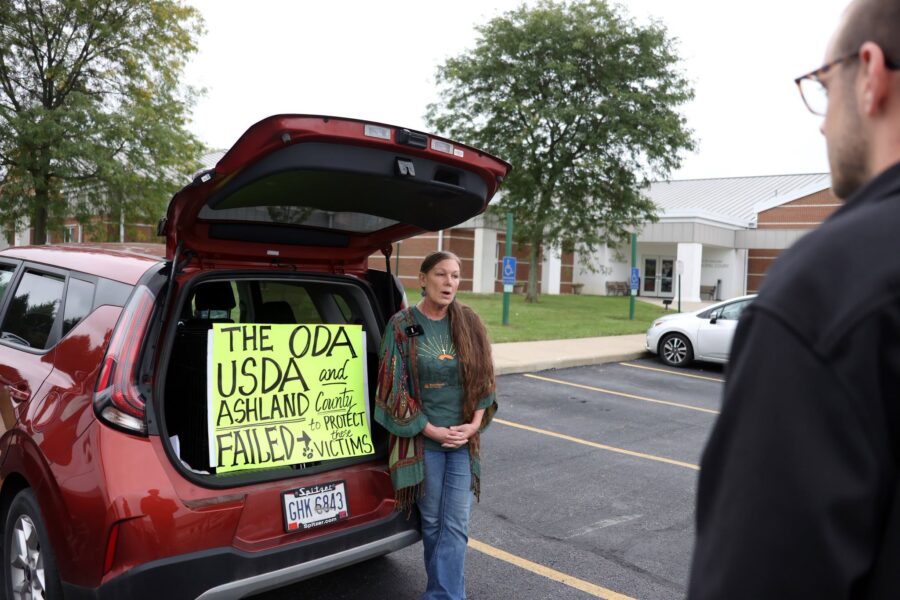
Tammy Kindle, founder of the animal-welfare organization Bark for All, spoke outside the courthouse after Rutschilling, 24, pleaded not guilty to six second-degree misdemeanor charges connected to an ongoing investigation involving Happy Mountain K9 Facilities near Loudonville.
Rutschilling faces five counts alleging that he knowingly organized, promoted, aided or abetted sexual conduct with an animal. He also faces one count of attempted cruelty to a companion animal.
According to court complaints, the alleged offenses occurred on several dates between Sept. 12, 2025, and March 7, 2026, at 362 Ashland County Road 2575, the address associated with Happy Mountain K9 Facilities, owned by Daniel A. Miller.
Judge John L. Good released Rutschilling on a recognizance bond. As a condition of that bond, Good ordered Rutschilling to have no companion animals or livestock in his possession, control or care while the case remains pending.
Rutschilling is scheduled to return to Ashland Municipal Court for a pretrial hearing at 1:30 p.m. Oct. 13.
Kindle said she was pleased with the court’s decision to prohibit Rutschilling from having contact with animals.
“As far as the way things went today in Judge Good’s courtroom, I am pleased that he enforced the fact that Mr. Rutschilling will not be allowed to be in the presence of any companion animals, any livestock animals whatsoever,” Kindle said. “I think that’s appropriate and called for.”
Despite supporting the bond condition, Kindle said she was heartbroken that the allegations against Rutschilling resulted in misdemeanor charges rather than felonies.
“The fact remains that currently, these people, if found guilty, will be sentenced under the current law,” Kindle said. “I would like to see that change. I know many folks would like to see that change, and people are working toward making that happen right now.”
The case is part of a wider investigation that began after authorities removed 72 dogs and puppies from Miller’s breeding operation.
Miller, 64, faces multiple charges in separate Ashland Municipal Court cases, including allegations of depriving companion animals of necessary sustenance and committing cruelty against companion animals. He also faces earlier charges of falsification to mislead a public official and obstructing official business.
Judge Good previously set Miller’s bond at $25,000 cash or surety and imposed a sweeping condition prohibiting him from possessing, keeping, controlling or harboring companion animals or livestock.
Kindle said Bark for All will return to Ashland for the Oct. 13 proceedings. She expects other animal-welfare organizations and advocates to attend as well.
“I hope to see several animal-rights groups here on that day,” Kindle said. “I know for certain Bark for All will be here. I know for certain PPOV will be here.”
Kindle said she believes the allegations have drawn significant concern from people across Ohio and within Ashland County.
“There’s a lot of support for animal rights here in Ohio, and I think that we can look forward to seeing a lot of those people take time in their day to come and show support,” she said.
Kindle said she launched Bark for All on Aug. 21 after spending approximately a decade working as an animal activist and puppy mill rescuer.
The organization’s name stands for
B- Breeder
A- Accountability
R- Registration
K- Kennel Inspections)
Rather than focusing solely on expanding animal rescue operations after dogs have already suffered, Kindle said her organization wants to address the conditions that allow alleged neglect or abuse to occur.
Her organization supports requiring anyone who breeds dogs with the intention of selling puppies to the public to become licensed and registered, regardless of how many dogs the person owns or breeds.
“Every dog matters,” Kindle said. “Anybody who wants to breed a dog and intends on selling those puppies to the public needs to be licensed and registered.”
Kindle argued that Ohio’s current system allows some breeders to operate outside state or federal licensing requirements when they remain below certain numerical thresholds.
She wants those thresholds eliminated.
“If that’s what matters to the state of Ohio, then license every dog that’s going to be bred,” Kindle said. “No more numeric thresholds.”
Kindle also claimed Ohio regulates liquor licenses more closely than it regulates commercial dog breeding.
“In the state of Ohio, they regulate liquor licenses better than they regulate living and breathing lives,” she said. “Right now, the state of Ohio is kind of an open game for dog breeding, and it’s completely out of hand.”
Kindle criticized what she described as inadequate oversight by the Ohio Department of Agriculture, the U.S. Department of Agriculture and past Ashland County leadership.
She argued that licensing requirements accomplish little if inspections are not performed consistently and violations are not addressed.
“If we’re going to continue to license people for dog breeding in the state of Ohio, they need to license every single dog,” Kindle said. “And we need people in place to make sure that these animals are protected.”
Kindle expressed hope that enforcement will improve now that the Ashland County Sheriff’s Office oversees dog-warden operations.
She also criticized the role of state taxation in puppy sales, saying that confirming whether a breeder is properly registered for tax purposes does not protect the buyer or the animals.
Kindle said the nature of the allegations did not surprise her because she has seen troubling conditions during years of animal-rescue work in Ashland, Holmes and Coshocton counties and elsewhere.
“I was not shocked,” Kindle said. “I am dismayed.”
She argued that profit can motivate some breeders to disregard the welfare of animals and that weak oversight removes the fear of consequences.
“I think that greed begins to drive people to commit certain atrocious crimes,” Kindle said. “When there’s also a deficit in the oversight and you’ve taken the fear of getting caught away, terrible things like this happen.”
Kindle also offered advice for people looking to purchase a puppy.
She cautioned buyers against relying solely on online advertisements or photographs and urged them to personally visit the property where the dogs are bred and housed.
“Do not ever buy a puppy online,” Kindle said. “You need to be able to visit the premises on which the dogs are being bred and sold, and you need to be able to see the nursing mother or the mother of the puppies that you’re interested in buying.”
She encouraged prospective buyers to ask breeders for access to the actual housing areas, not simply a clean building or meeting space used to show puppies to customers.
“Ask to see where they’re being housed, where they’re being kept,” Kindle said.
Reputable breeders, she added, should be willing to show where their dogs live and should also carefully screen the people seeking to purchase their puppies.
“At this point in time, I think the only thing that one can do to try to ensure that they are working with a reputable breeder is to show up yourself, boots on the ground, to the actual facility,” Kindle said. “Reputable breeders, in my experience, want to be careful about who they adopt their pets out to and are happy to show the area in which the pets are housed and cared for.”
Rutschilling’s case and the separate cases against Miller remain pending in Ashland Municipal Court.
The charges against Rutschilling and Miller are allegations. They are presumed innocent unless proven guilty in court.