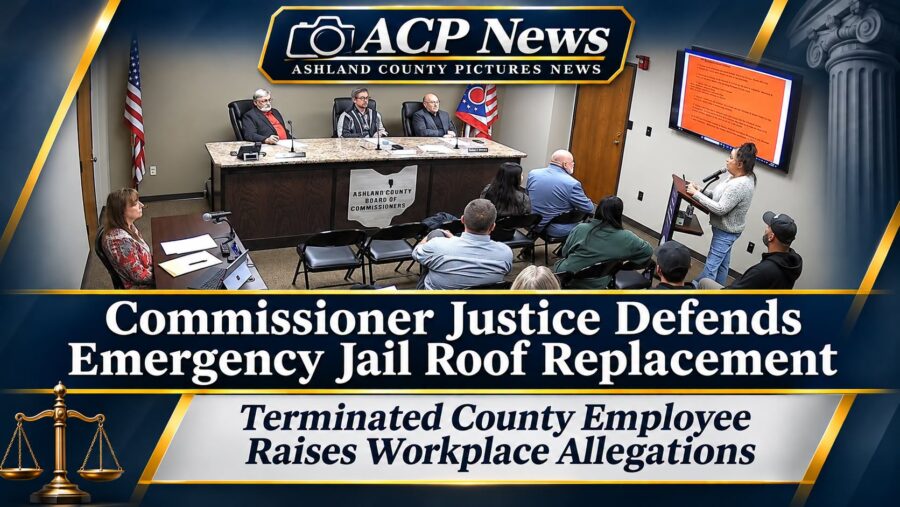

Commissioner Justice Defends Emergency Jail Roof Replacement; Terminated County Employee Raises Workplace Allegations
ASHLAND, Ohio — Ashland County Commissioner James Justice defended the emergency replacement of the county jail roof Tuesday, responding to concerns raised by the county’s juvenile court judge regarding the project and its impact on planned courthouse improvements.
The November 24, 2026, Ashland County Commissioners’ meeting also included workplace allegations from a recently terminated county employee, an extensive conservation district update and approval of several financial and administrative matters.
Commissioners Michael Welch, president; Denny Bittle, vice president; and James Justice were present. Pastor Keith Tyson of Ashland Brethren in Christ Church offered the opening prayer.
Justice Responds to Juvenile Judge’s Letter
Justice addressed three concerns outlined in a November 18 letter from the juvenile court judge, including whether an emergency existed at the jail, the absence of a comprehensive capital facilities plan and whether meaningful opportunities for participation had been provided.
Responding to the first concern, Justice described conditions reported by Ashland County Sheriff Kurt Schneider.
According to Justice, leaks throughout the jail required approximately 60 buckets to collect water entering the building. Employees working in the intake area reportedly had to use umbrellas indoors to protect themselves from water pouring through the roof.
County maintenance supervisor Nick Lamp advised commissioners that the entire roof needed replacement.
Justice described the roof as a problem that had persisted for 26 years, with the county repeatedly patching it because of the cost of replacement.
“We have to do something because patching it is no longer an option; there are too many holes,” Justice stated.
He also cited information from Garland indicating that replacing the entire roof now rather than delaying the project could save approximately $500,000.
Courthouse Project Delayed, Not Forgotten
Justice acknowledged that prioritizing the jail roof would delay planned courthouse improvements but maintained that the other committee members agreed the jail project constituted an emergency.
“I’m sorry the jail roof has to delay the judge’s project; but we haven’t forgotten the courthouse, but we won’t borrow money for that project,” Justice stated.
Addressing concerns regarding participation, Justice referenced a previous 90-minute special commissioners’ meeting during which the juvenile judge had an opportunity to ask numerous questions.
“I understand she left during the meeting, but she meaningfully participated,” Justice stated. “We were all here when she did that. And we appreciate her participation.”
The judge’s original November 18 letter was not included in the materials reviewed. Her concerns are presented as characterized by Justice.
Terminated County Employee Raises Workplace Allegations
Commissioners unanimously authorized the termination of probationary county employee Monica Mateo, effective November 20, citing unsatisfactory job performance.
Before the vote, Mateo addressed commissioners, disputing the circumstances surrounding her dismissal and describing two incidents involving county vehicles.
Mateo alleged that during the first week of November, her supervisor struck her assigned work vehicle while operating another county vehicle inside the maintenance garage.
She claimed her supervisor subsequently asked her not to report the damage.
“He told me to keep it quiet. I kept it quiet,” Mateo said.
Mateo acknowledged that she was wrong for failing to report the incident.
A second incident involved damage near the rear driver’s side of a vehicle. Mateo said surveillance footage appeared to show that she struck the vehicle while backing out of a crowded parking lot, but maintained she did not feel or realize a collision had occurred.
Mateo then raised allegations concerning conduct of a sexual nature during her employment.
“There’s been talk and things going on that I’m embarrassed to talk about,” Mateo said. “It’s very sexual, and I would prefer not to talk about it on mic.”
She indicated that the alleged conduct began approximately two to three weeks after she started working for the county.
Mateo announced that she intended to contact law enforcement following the meeting.
“I am going to file charges and make a report at the police department after this meeting,” she said.
Commissioners did not publicly address the substance of her allegations before unanimously approving the termination.
Mateo’s allegations have not been independently verified by ACP News. It remains unknown whether she subsequently filed a police report.
Soil and Water Conservation District Requests $150,000
The Ashland Soil and Water Conservation District requested that its local appropriation for soil and water programming be increased to $150,000 for 2027.
District leadership reported that, for the second consecutive year, every dollar invested locally in conservation programming has brought more than $8 back into Ashland County.
Much of that funding comes through H2Ohio, the Ohio Department of Agriculture and the Muskingum Watershed Conservancy District.
Ashland County farmers reached their initial 10,000-acre H2Ohio enrollment limit by noon on the first day. One producer even signed his contract from a hospital bed while recovering from a broken hip.
Additional acreage subsequently became available, allowing the county to exceed 20,000 acres enrolled in nutrient management programming.
The district reported several accomplishments:
More than 15,000 acres of cover crops, including approximately 11,000 additional acres planted this fall.
More than 3,800 linear feet of streambank protected through livestock exclusion fencing.
84 water quality samples collected.
79 educational classroom visits.
More than 3,000 youth participants in educational programming.
Ashland County was also selected as one of eight Ohio counties to participate in a five-year grazing pilot program.
The initiative provides free soil testing for pasture and hay ground, $10-per-acre cost-sharing assistance for grazing management plans and up to $15,000 for qualifying livestock stream exclusion projects.
The district continues developing watershed conservation plans and expanding educational opportunities through its partnership with the county’s solid waste program.
Its next Conservation Chat is scheduled for December 9 and will address Ohio drainage law and floodplain regulations.
Commissioners praised the district’s growth and ability to attract outside funding.
Commissioners Approve Additional County Business
Commissioners unanimously approved several additional matters:
Human Resources Manager: Elizabeth Lander was appointed human resources manager for Ashland County Job and Family Services at $33 per hour, effective December 7.
Humane Society Cases: Commissioners authorized $787.50 in legal expenses associated with the prosecution of six pending Humane Society cases.
County Engineer Travel: A $2,000 travel request was approved for County Engineer Edward Mesner to attend the National Association of County Engineers conference in Cleveland, April 5–9, 2027.
Landfill Monitoring: Commissioners accepted a $115,495 proposal for the county’s 2027 post-closure landfill monitoring program. Officials expressed hope that annual monitoring requirements could end within approximately five years, subject to state approval.
Lease Agreement: Commissioners approved a one-year lease involving Job and Family Services building and parking facilities at 15 West Fourth Street, listing a rate of $3,756.33.
Planning Commission: Burton Williams and Steve Workman were reappointed to three-year terms beginning January 1, 2027.
Commissioners also approved numerous year-end appropriations and transfers, explaining that such transactions are customary as departments reconcile their budgets.
The meeting highlighted the competing financial priorities facing Ashland County heading into 2027, particularly aging county facilities, personnel expenses and continued investment in local conservation programs.