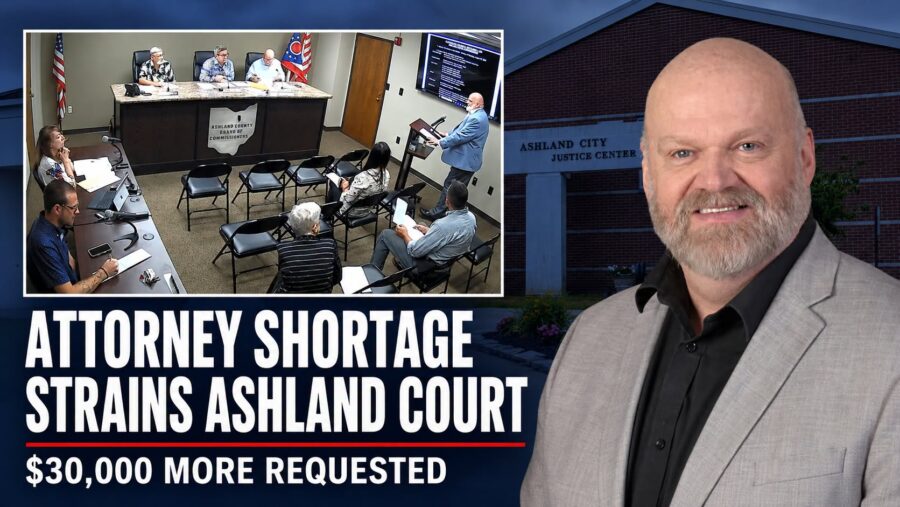

Judge Good Warns Attorney Shortage Is Straining Ashland County Court System
Ashland Municipal Court seeks additional funding as rising caseload and shortage of local attorneys drive up costs
ASHLAND, OHIO — Ashland Municipal Court Judge John Good warned county officials Thursday that a shortage of local attorneys, growing caseloads and increased demand for court-appointed counsel are placing mounting pressure on the local court system.
Good appeared before Ashland County Commissioners President Michael Welch, Vice President Denny Bittle and Commissioner James Justice during their Sept. 3 meeting. He requested an additional $30,000 for the court-appointed counsel fund and encouraged commissioners to examine whether Ashland County’s current system remains sustainable.
“We have an issue, and that issue is that we do not have enough money left in our court-appointed counsel fund to pay our liabilities for the rest of the year,” Good said.
The county appropriated $85,000 for court-appointed counsel in 2026, the same amount provided last year. However, approximately $10,000 of the current budget was used to cover attorney bills connected to 2025 cases.
Good said $4,792.50 in unpaid bills from December were carried into January. Attorneys also submitted another $4,867.50 in delayed bills for work performed during November and December.
Court officials estimate another $30,000 will be needed to cover expenses through the end of 2026. Good noted that approximately 80% of eligible court-appointed counsel costs are currently reimbursed by the State Public Defender’s Office, provided the bills are submitted within the required timeframe.
That means the full $30,000 would not ultimately fall on county taxpayers, although Good cautioned that the state reimbursement rate could change in the future.
Court filings continue to climb
According to Good, Ashland Municipal Court recorded 8,172 new filings through the end of August and is on pace to surpass 12,000 cases this year.
The court’s 2025 annual report lists nearly 11,700 traffic and criminal cases filed, with the Ohio State Highway Patrol responsible for more than 8,200 filings. The Ashland County Sheriff’s Office accounted for more than 1,700 cases, while the Ashland Police Department filed more than 1,300.
Good said the court had approved appointed attorneys in 201 cases through August, compared with 180 during the same period last year, an increase of approximately 12%.
Appointed attorneys are provided when defendants are financially unable to hire legal representation and face charges carrying the possibility of jail.
Good attributed the rising expenses to four primary factors: unpaid bills carried over from 2025, an increasing number of cases, more defendants qualifying for appointed counsel and higher costs associated with securing attorneys.
“Growth costs money, and we’re experiencing that,” Good said. “We’re experiencing additional costs because we have additional caseload.”
Only two local attorneys remain available
Good told commissioners he is down to only two Ashland County attorneys regularly willing to accept court-appointed cases.
The county pays appointed attorneys $75 per hour, while Good said private clients are typically charged between $150 and $200 per hour. The lower rate and heavy workload have made it increasingly difficult to recruit attorneys.
“We have a lawyer shortage like every other rural county in Ohio,” Good said. “It’s everywhere across the state.”
Good said he prefers appointing local attorneys because county tax dollars remain in the local economy and because he believes defendants receive quality representation. However, the limited number of available attorneys has created scheduling problems and forced the court to rely increasingly on lawyers from outside Ashland County.
“It’s legitimately a crisis,” Good said. “People can’t find representation in Ashland County.”
The shortage is not limited to criminal cases. Good said residents seeking attorneys for divorces and other domestic-relations matters often must look to Mansfield, Wooster or other communities.
Commissioners asked to examine alternatives
Good asked commissioners to study other methods of providing indigent legal representation.
According to information he presented, 39 of Ohio’s 88 counties continue using appointed private attorneys. Twenty-nine counties operate county public defender offices, while 10 contract with the Ohio Public Defender to provide services through a local branch office.
Another option would be contracting with a nonprofit organization to provide representation.
Good said larger counties frequently operate public defender offices, although comparable counties such as Wayne, Knox, Delaware and Coshocton have also adopted that model. He cautioned that establishing an office would require salaries, equipment, office space and other operating expenses.
“I suspect you’re going to find this is still the cheapest way to do it for a county our size,” Good said of the current appointment system. “But I really don’t know that.”
While Good said he personally prefers the existing system, he urged commissioners to investigate the alternatives because finding qualified attorneys is becoming increasingly difficult.
“I would prefer you seriously look at other options because I think we have to,” Good said. “It’s hard to find competent Attorneys who are willing to take appointed cases.”
Commissioners indicated they would research the costs and benefits of establishing a county public defender office or contracting with the state. They also said other county judges should be included because any change would affect multiple courts.
No final decision on changing the system was made during Thursday’s discussion.
Court operating two courtrooms simultaneously
The attorney shortage is only one symptom of the court’s increasing workload.
Good said Ashland Municipal Court currently operates two courtrooms simultaneously about a day and a half each week, with Good presiding in one and a magistrate handling proceedings in the other. The court may soon increase that schedule to two and a half days per week.
Running two courtrooms requires two clerks, two bailiffs, prosecutors and additional support personnel.
Good said the court sometimes schedules approximately 50 hearings in one day. On one recent afternoon, the court handled 26 pretrial hearings, an expungement motion, an assault sentencing and a wedding.
“We can’t keep up if we don’t do that,” Good said of using both courtrooms. “And that is also just going to get worse.”
Good said Mansfield Municipal Court handles a caseload similar to Ashland’s but has two judges. He considers it unlikely that the state will authorize an additional municipal court judge for Ashland County, leaving expanded use of magistrates and court staff as the more realistic response.
Commissioners said they want to examine the issue with the county’s future growth in mind rather than waiting for the existing system to become unworkable.