
More Than a School: Ashland County Community Academy Helps Students Find Their Path
ASHLAND, Ohio — When questions about Ashland County Community Academy began circulating in a community forum, Ashland County Pictures went looking for answers. A visit to the school, conversations with its leaders and a firsthand look inside its classrooms revealed a small, inspiring learning community built around students who need a different path to graduation.
At ACCA, education is personal. Staff members respond to barriers with flexibility, helping students who once doubted their futures recognize that success remains within reach.
Ashland County Community Academy, commonly called ACCA, operates at 716 Union St. in Ashland. The public charter school specializes in dropout prevention and recovery, serving students who may have struggled academically, socially or personally in a traditional high school.
School leaders said they want the public to understand something clearly.
“This is not the school for bad kids,” staff member Nichole Helenthal said. “This is a school for kids where the regular system just doesn’t work.”
Before becoming an official public charter school in 2008, ACCA operated as an alternative education program through Ashland City Schools. The Ohio Department of Education and Workforce sponsors the school, which awards state-recognized high school diplomas.
“We are not a private school, and we’re not operated by a for-profit entity,” Superintendent Donne Copenhaver, Ed.D., said. “We’re in partnership with the state itself to remain a public charter school.”
Small by Design, Personal by Purpose
ACCA’s size is one of its most noticeable differences. The school deliberately maintains manageable enrollment and class sizes, giving educators more opportunities to develop meaningful relationships with students and their families.
“We are small by design,” Copenhaver said. “In order to be different, you have to do different.”
The setting allows teachers to understand not only where students stand academically, but also what they may be facing beyond the classroom.
Rather than expecting every student to follow the same route, ACCA creates an individual success plan based on each student’s needs, responsibilities and goals.
“We want to be able to work effectively with every individual student and every individual family,” Copenhaver said. “Everybody should feel like they’re being reached at their level, where they are.”
Principal Chris Gilbert said strong relationships build trust. When students feel safe enough to discuss what is happening in their lives, staff members can better identify the support they need.
“This student needs this, and another student needs something different, and that’s OK,” Gilbert said. “Every student has their own pathway.”
For one student, that support may involve changing a schedule because the student works late to help provide for a family. For another, it may mean offering a quiet moment after a difficult night instead of responding immediately with discipline. Some students need help recovering credits they missed or failed in earlier years.
ACCA does not lower its expectations. Its approach focuses on clearing away unnecessary obstacles that stand between a student and graduation.
Meeting Students Where They Are
The academy follows a four-day school week, with classes held Monday through Thursday. Its program combines classroom instruction with flexible blended-learning opportunities.
That flexibility can make a critical difference for students who have jobs, health concerns, children to care for or other responsibilities outside school.
Some students rely on their employment to help their families survive. Instead of viewing that work as a distraction from school, ACCA searches for ways to make it part of the student’s education and award eligible academic credit.
“We want to honor that with those kids and figure out a way that they can do what they need to do in their life but still stay in school,” Copenhaver said. “That’s really what it’s all about.”
Through its Career-Based Intervention program, ACCA helps students strengthen workplace skills, prepare for interviews, secure employment and participate in internships. Projects such as the school store, student newspaper and yearbook also provide hands-on experience.
Along the way, students learn responsibility, teamwork and the value of meeting a deadline.
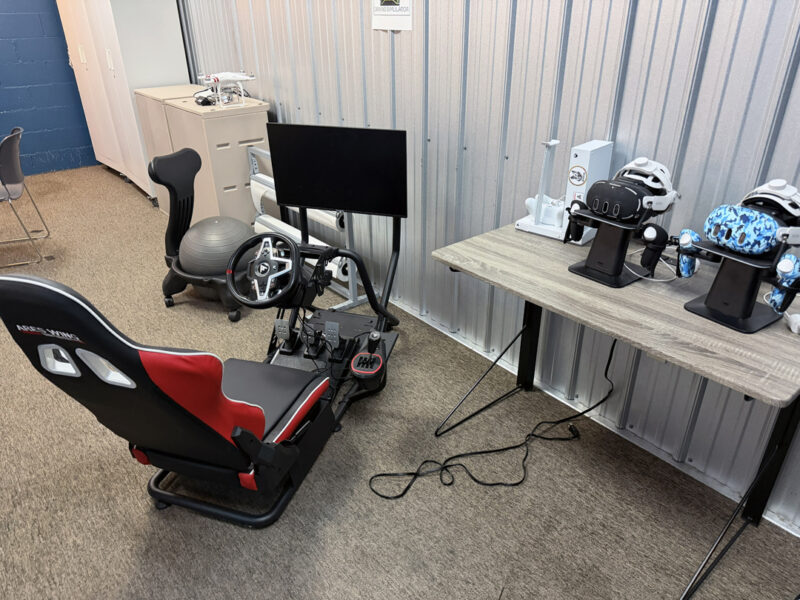
ACCA also offers free driver’s education, including online coursework and behind-the-wheel instruction. Staff members said few Ohio schools provide such an opportunity.
For a student preparing to join the workforce, a driver’s license may be the difference between facing limited choices and being able to travel to a job independently.
Turning “I Can’t” Into “I Can”
Many students arrive at ACCA with little confidence in themselves, Helenthal said, even though they possess the intelligence and ability to succeed.
“They desperately want a place where they feel like they belong,” she said. “We build up their confidence that they are smart, that they can do this and that their future can be something different from what they imagined at the beginning.”
One former student’s experience shows what patience, support and another chance can accomplish.
Helenthal had known him since middle school and watched as he endured years of difficulties. Fighting once appeared to be his quickest response to conflict, and his circumstances put him at serious risk of leaving school.
He did not leave.
The student graduated, obtained full-time employment and began supporting his own family. Staff members now describe him as responsible, dependable, hardworking and a wonderful father. He also has skills in automotive repair, concrete work, and heating and cooling.
“Seeing that change in him from middle school to now, and knowing that maybe we had some small part in helping him get there, you can’t ask for anything more,” Helenthal said. “It almost gets you teary-eyed when you think about it.”
Copenhaver said that transformation speaks to the student’s resilience as well as the school’s responsibility.
“It takes 100% from everybody to make it work,” he said.
A Message Finally Takes Hold
A recent exchange between two students offered another glimpse of ACCA’s impact.
One student announced that he planned to drop out. Before a staff member had time to respond, a second student threw up his arms and asked, “Why would you drop out now?”
The response carried special weight. Just one year earlier, that same student had repeatedly talked about quitting school and needed others to persuade him to stay.
Now, he was the one urging a classmate not to give up.
“It kind of gives you chills,” Helenthal said. “Some of this is actually sinking in. It resonated somehow.”
The brief exchange reflected what ACCA strives to create: young people encouraging one another, realizing that their choices carry consequences and recognizing opportunities where they once saw only dead ends.
Changing the Environment and the Perception
Several years ago, ACCA experienced significant staff turnover. Copenhaver credited Gilbert and the current faculty with rebuilding the school into a welcoming, understanding environment focused on keeping students engaged.
Staff members still address inappropriate behavior, but they first try to learn what caused it.
When a student enters class with his head down or appears visibly upset, the first question may not be, “How should this student be punished?”
Instead, staff members ask, “What happened?”
“Students have told me they’ve never had a principal where they feel like they can just walk in and talk to him like they can with Chris Gilbert,” Helenthal said.
Gilbert believes each ACCA student has developed a positive relationship with at least one adult in the building. That person checks in, listens and often becomes an unofficial mentor.
For some students, that kind of connection may have been the missing piece in a larger, more traditional school setting.
According to Copenhaver, ACCA’s most recent state report card rated the school as exceeding standards. The designation reflects its work with students who face the risk of leaving school or failing to graduate on time.
ACCA awards a legitimate, state-recognized high school diploma. Students can finish their graduation requirements, recover lost credits and receive career preparation. They may also continue working toward completion when graduating within the traditional four-year timeline is no longer realistic.
School leaders recognize that changing long-standing perceptions about alternative education will not happen overnight. Inside ACCA, however, the reality looks far different from the stigma that has sometimes followed such schools.
Teachers refuse to give up. Students begin to recognize their own worth. And the school adjusts its approach so young people do not have to abandon their futures.
“This school is truly here for the students,” Helenthal said. “We will bend over backward to help them figure out the best way to learn, move forward and have a good future.”
Interested in learning more about Ashland County Community Academy?
Ashland County Community Academy serves students in grades 9–12 and welcomes families who would like to learn more about the school and its programs. Families interested in enrollment can contact the school at 419-903-0295 (tel:419-903-0295) or visit http://accaaces.org for more information. Prospective students and their families are also welcome to schedule a tour to visit the school, meet our staff, and learn more about the opportunities available at ACCA.
ACCA will also host an Open House on October 21 from 4:00–6:00 p.m., providing another opportunity for families and community members to visit the school, meet staff, tour the building, and learn more about our programs and opportunities.