
Ancient Earthworks Reveal Ashland County’s Prehistoric Past
ASHLAND COUNTY — Long before pioneers pushed through the dense hardwood forests of what would become Ashland County, prehistoric people lived, traveled, hunted and buried their dead along the rivers and valleys of north central Ohio.
For Kenneth Hammontree, the fascination with Ohio’s ancient past began in the summer of 1962, when he was growing up near Uniontown and Hartville, Ohio, just a few hundred yards from the Tuscarawas River.
Each spring, after farmers plowed the rich bottomland soil, neighborhood children would ride their bicycles to the fields and spend hours walking the freshly turned earth. There, they often found Native American artifacts, including arrow points made hundreds, and sometimes thousands, of years earlier.
“There were no cell phones or computers back then,” Hammontree recalled. “We just played outside, climbed trees, drank water from the hose and spent summer days exploring.”
One afternoon, while walking farther down the river, Hammontree and his friends discovered a large mound. A neighbor, who was a full-blooded Huron Native American, went with them to see the ancient site. That summer, the children helped clear trees from the mound and explored the area, where they found various artifacts.
But everything they discovered was left where it was found.
Their Huron friend told them it was the right thing to do, out of respect for the ancient mound and the people who had built it.
That summer became Hammontree’s introduction to Ohio’s prehistoric mounds and artifacts, a lifelong interest that would later lead him to investigate the ancient earthworks of Ashland County.
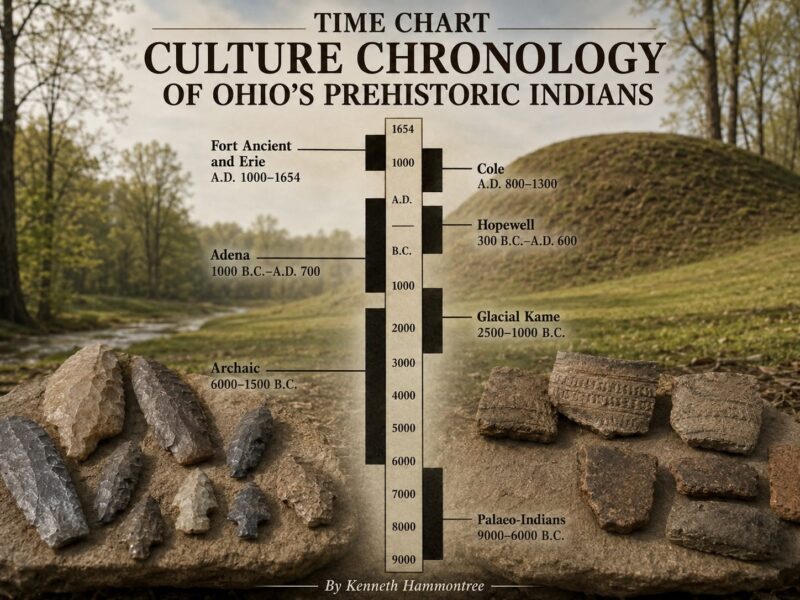
Ohio is widely known for its prehistoric mound builders. Across the state, thousands of mounds and earthworks once dotted the landscape, representing ancient cultures including the Paleo, Archaic, Adena, Hopewell, Cole, Fort Ancient and Erie peoples. Among the most famous are the Marietta Earthworks, Mound City, Fort Ancient and the Great Serpent Mound.
Hammontree’s research into Ashland County’s ancient sites led him to the rare reference book History of Ashland County, written by A.J. Baughman and published in 1909 by S.J. Clarke Publishing Company. The book documents several mound and earthwork locations throughout the county.
Much of Hammontree’s investigation focused on the Black Fork Valley, especially areas that were once part of Richland County before being added to Ashland County in February 1846. Before that time, Ashland County was formed from portions of Richland, Huron, Wayne and Lorain counties.
According to Hammontree’s research, numerous prehistoric mounds and earthworks once stood throughout Green Township, particularly near the Black Fork River and the former site of Old Greentown.
On the southwest corner of Section 17 in Green Township, about a half mile northwest of Old Greentown, there was once a circular embankment about five feet high covering approximately half an acre. In the center stood another large mound containing artifacts and human remains. Around 1890, the mound was opened and identified as a burial site.
Additional ancient mounds were found in Sections 18, 19 and 20 of Green Township, all near the Black Fork River. Also near Old Greentown, in Section 17, was a circular earthwork reportedly seven feet high that enclosed about three acres.
Another large circular enclosure, covering about two acres, was once located within the present city limits of Ashland, just north of the Erie Railroad. The land was owned by Henry Gamble. When the first settlers arrived in 1812, they found embankments standing three to four feet high, with large hardwood trees growing in and around the earthworks, evidence that the site had stood for centuries.
Other sites were found in Orange Township and Jackson Township. One large mound, known as the Norris Earthworks, was opened around 1900, revealing artifacts and human bones. In the northeast corner of Sullivan Township, a deposit of flint tools and implements was discovered and believed to be connected to the burial of a person of importance.
One of the largest earthworks in Ashland was located along Town Creek, near the present-day Center Street bridge where the city parking lot now sits. That site was a burial mound containing nearly 50 skeletons and numerous artifacts. Hammontree noted that, unfortunately, the site was desecrated and artifacts were removed as Uniontown, now Ashland, began to expand.
In Jackson Township, near the Muddy Fork Valley on land once owned by John Ramsey, a large quadrangular earthwork enclosed about two acres. Early settlers described the embankment as being about three feet high, with timber inside the enclosure equal in size to the dense forest surrounding it.
Near the Jerome Fork, another circular enclosure covered nearly three acres and was located close to a large spring. In 1812, the embankment reportedly stood about four feet high.
Numerous smaller mounds were also discovered around 1900 in Hanover Township, particularly in Sections 11, 12, 13 and 14, not far from the Mohican River and the Black Fork of the Mohican River. Many of those sites contained artifacts and human remains.
Hammontree said the locations of these ancient sites reveal an important pattern: rivers and creeks were key travel routes for prehistoric people. The Mohican River, the Black Fork and the many streams flowing into them made Ashland and Richland counties a busy highway in ancient times. Bison trails also crossed the region, helping shape travel routes long before roads or settlements existed.
Today, many of Ashland County’s prehistoric mounds have disappeared, lost to farming, construction and the growth of towns and villages. Hammontree estimates that perhaps 20 to 30 more prehistoric mound sites once existed in the county but have long since vanished from the landscape.
Still, their story remains part of Ashland County’s deeper history.
Long before pioneer cabins, railroads, farms and city streets, prehistoric people left their fingerprints on the land. Their earthworks, burial mounds and artifacts are reminders that Ashland County was home to human life and culture thousands of years before the first settlers arrived.
In the next article, Hammontree will explore the prehistoric Indigenous people who lived in Ashland County and the legacy they left behind.
Ken adds one more thing, Please if you know or come across a mound, out of respect, do not dig or removed anything from it.